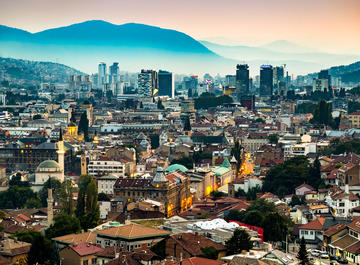
There is a group of people in Sarajevo. Some have been friends for many years, while others met only recently, but today they are united by the same idea and the same sense of responsibility. Since February 2024, every Tuesday evening, they gather by the Eternal Flame, a symbol of antifascism and resistance in the very heart of Bosnia and Herzegovina’s capital, to read aloud the names of Gaza’s murdered children.
OBCT joins today's strike, to support the humanitarian and nonviolent mission of the Global Sumud Flotilla and denounce the genocide we are witnessing in Gaza
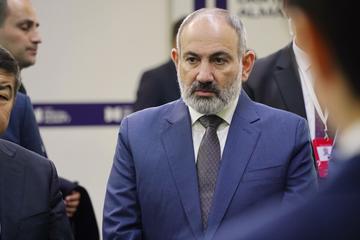
After meetings between Armenia, Azerbaijan, and Türkiye, optimism is growing for a peace treaty by 2026. Yerevan hopes to reopen its border with Ankara. Pashinyan is aiming for concrete results to strengthen his fragile political position
Boris is leaving for Gaza with other activists on the Sumud Flotilla. His motivation is his witnessing the siege of Sarajevo as a young man and his great frustration today, as a humanitarian professional and an Italian-Bosnian citizen, at not being able to deliver aid to Gaza. A reflection on humanitarian law and being an activist
Thirty years after the Srebrenica genocide, we are witnessing another genocide unfold live-streamed. What we once fought for, and the institutions born out of that earlier tragedy, have failed to prevent the obliteration of Gaza. A reflection by Luisa Chiodi, Director of OBCT, and a heartfelt appeal not to surrender to resignation
In what has been described as a historic event, Yerevan and Baku moved closer towards peace this month at a trilateral meeting hosted and facilitated by U.S. President Donald Trump. His counterparts from Armenia and Azerbaijan, Nikol Pashinyan and Ilham Aliyev, said they would nominate him for the coveted Nobel Peace Prize
Surprise comments made last week by the Azerbaijani Foreign Minister revealed that the text of peace treaty with Armenia has been finalised. The move was widely welcomed internationally, though questions remain as to where and when the landmark agreement will be signed
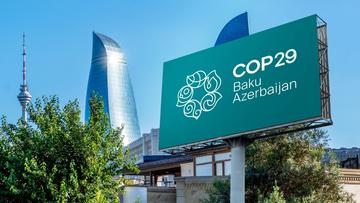
With less than a month left before the United Nations Climate Change Conference in Baku, the clock is ticking down on any potential document to be signed by Armenia and Azerbaijan to end over three decades of conflict
Last August, the One Caucasus Festival brought together Armenia, Azerbaijan and Georgia through music, culture and educational and participatory projects. An example of how communities can build a peaceful future together
Following a landmark decision by Yerevan and Baku to delimit part of the Armenia-Azerbaijan border, efforts towards an agreement to normalise relations move forward despite anti-Pashinyan protests in Yerevan
Armenia and Azerbaijan issued a late-night joint statement that surprised even the most seasoned of commentators. Though it remains unclear whether this could be a long-awaited breakthrough in negotiations, the international community was united in welcoming the move
In recent days, Georgia once again hosted the Tbilisi Silk Road Forum, an event with an economic focus. What is new this year is that for the first time an Armenian leader spoke at such a high-level event in Tbilisi, and high-level officials from all three South Caucasus countries were also on the same stage
Following the 20 September ceasefire agreement between Baku and the de facto authorities of the former Nagorno Karabakh Autonomous Oblast (NKAO), now Armenian Prime Minister Nikol Pashinyan and Azerbaijan President Ilham Aliyev are expected to meet for talks that will also involve France, Germany, and the European Council
Nikola was just a few months old when, in August 1995, his family – together with the other 200,000 people of Serbian nationality, left Croatia in a hurry. After living in Serbia for fifteen years, he returned to Croatia where he attended high school and where he still lives and works. We met him
Another meeting took place on saturday 15 july among Armenian Prime Minister Nikol Pashinyan and Azerbaijani President Ilham Aliyev, facilitated by European Council President Charles Michel
US Secretary of State Antony Blinken said Armenia and Azerbaijan made further progress towards a peace deal in the three-day US-hosted talks in late June, yet tensions persist in the disputed territory of Nagorno Karabakh
What is the impact over the Western Balkans of the Russian invasion of Ukraine? What are the possibel future scenarios in Serbia and Bosnia and Herzegovina? Analysts, activists and area experts discussed it in a webinar organized by OBCT and CeSPI
A tight series of talks and meetings attended by Nikol Pashinyan, prime minister of Armenia and Ilham Aliyev, president of Azerbaijan, took place in various locations, from Moscow to Chişinău and even in Ankara. The goal was to seek the normalisation of relations between Yerevan and Baku
On Sunday, 14 May, Armenian Prime Minister Nikol Pashinyan and Azerbaijan President Ilham Aliyev met in Brussels for renewed talks hosted by European Council President Charles Michel. Still many unresolved points but some small progress appears
From 1 to 4 May, the United States hosted a meeting of talks between the Armenian Foreign Minister and his Azerbaijani counterpart. Few details of the meeting: there was some progress but points of disagreement remain on some key issues
On 20 February the European Union Mission in Armenia (EUMA) started observing the country’s fragile border with neighbouring Azerbaijan. EUMA is a tool to create a more conducive environment for negotiations between Yerevan and Baku
Hopes and tension at Munich Security Conference as Armenian and Azerbaijan leaders meet to discuss a peace treaty. The initial optimism for the historic meeting soon gave way to unresolved tensions between Pashinyan and Aliyev
The European Monitoring Capacity (EUMCAP) is the short-term EU mission deployed on the borders between Armenia and Azerbaijan with the aim of reducing tensions between the two states and strengthening their mutual trust
In Cyprus, cooperating across the lines that divide Greeks and Turks is always complicated. Also thanks to EU intervention, however, halloumi cheese – one of the symbols of the island – is once again a heritage shared by the two communities
First the pandemic, now the price crisis have been increasingly pushing the Greek and Turkish communities of Cyprus to cross the de facto boundaries that divide them and to interact, despite the persistence of prejudices and mutual distrust. A reportage from the island
Almost thirty years after the genocide we are very far from starting a dialogue and a public discussion – in Bosnia and Herzegovina and in Europe – on the memory of what happened in Srebrenica. An interview with Andrea Rizza Goldstein
In the 1990s Alexander Langer, a South Tyrolean politician and MEP, devoted a great deal of effort to seeking peaceful solutions to the conflict in Bosnia. His writings have now been translated into Bosnian and will be the core of meetings for young people on human rights, ecology, and activism
The European Federation of Journalists (EFJ) interviewed Nadezhda Azhgikhina, Russian journalist, director of PEN-Moscow, and former Vice-President of the EFJ. Her views on media in the ongoing war
It is now clear that constitutional reform in Bosnia and Herzegovina is as necessary as it is difficult. A possible solution could come from participatory constitutionalism